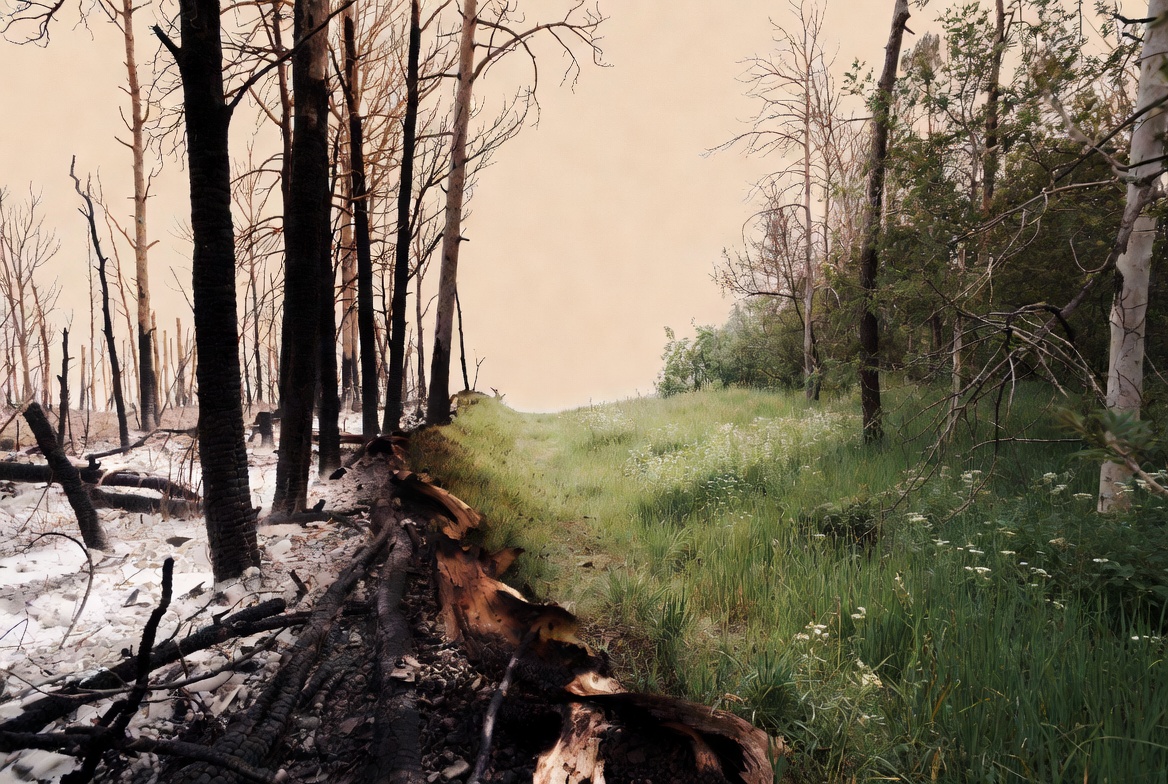


Most people treat the transition between two states as a bridge - a thin, precarious line to be crossed as quickly as possible. We want to minimise the time spent suspended. We want to rush the construction of the "new" so we can stop feeling the haunting absence of the "old."
But when you leave a career, a system, or a long-held identity, you don't enter a bridge. You enter a void.
This is the geometry of the gap: a space that is neither the past you’ve dismantled nor the future you haven't yet built. It is a hollow, and our instinct is to fill it immediately with noise, new plans, and frantic productivity to avoid the weight of the silence.
The Refusal to Resolve
The discomfort of the gap isn't a malfunction; it is a mechanical necessity.
In physics, a phase transition - like water turning to steam - requires a massive input of energy without an immediate change in temperature. It looks like nothing is happening. It looks like a plateau. But internally, the molecular structure is being entirely reorganized.
If you rush to "resolve" the gap by jumping into the first available opportunity, you are essentially short-circuiting your own evolution. You are taking the old version of yourself and trying to shove it into a new context. To truly expand, you must be willing to inhabit the void long enough for the "old world" to fully exit your system.
The Myth of the "Clean" Break
We want our exits to be clean, surgical, and linear. We want a narrative that makes sense. But the geometry of the gap is messy. It is a period of Revisionist History, where your brain, stripped of its usual armor of "expert status" and "predictable routine," starts to romanticize the very constraints you just fought to escape.
In this void, fear masquerades as a memory of stability. It tells you the gap is a "hole" - a lack, a failure, a sign of decline.
But sovereignty is found in the refusal to see the void as a hole. When you stop trying to "fill" the space and start seeing the WHOLE of the experience, the geometry shifts. The void is not an empty room; it is a clearing.
Reclaiming Authority in the Silence
When you are in the gap, you are finally without a script. There are no performance reviews here. There is no external authority to tell you if you are "thriving" or "surviving."
This is where the real work happens. Inhabiting the void is the ultimate act of reclaiming your sovereignty. It is the moment you decide that your state is no longer tied to an external outcome or a professional label.
- The Problem: I don’t know who I am without the title.
- The Teacher: You were never the title; you were the presence that inhabited it.
Kneeling in the Clearing
If you are currently in the gap - feeling the friction of being "between" - stop trying to build the bridge. Stop looking for the data points that will tell you when you’ll be "safe" again.
The gap is the only place where the "open-tap" life can actually begin, because it’s the only place where you aren't already filtered by the expectations of a system.
Kneel in reverence for the silence. You are not lost; you are being de-indexed from a story that was too small for you. The clarity isn't at the end of the gap. The clarity is the capacity to stand in the gap without flinching.